
Home › Fleas › Pet-Safe Flea Treatment
Pet-Safe Flea Treatment for Fresno Homes
You treated the pet, but the fleas keep coming back. That is because most of the infestation lives in your home, not on your dog or cat. We treat the whole house, safely around pets and kids, and break the cycle for good.
If you have flea-treated your dog or cat and the fleas still will not quit, you are not doing it wrong — you are only treating part of the problem. The adult fleas on your pet are less than five percent of an infestation. The other ninety-five percent — eggs, larvae, and pupae — is living in your carpet, your pet’s bedding, and the cracks of your floors. Our pet-safe flea treatment goes after that hidden majority, in your Fresno home, with products and timing chosen to be safe around the pets and kids who actually live there.
Treating the pet alone never clears a home infestation. We treat the interior with a flea adulticide plus an insect growth regulator (IGR) that stops eggs and larvae from maturing, coordinate with your pet’s vet product, and follow up to catch the pupae that hatch after the first visit — the wave that defeats most DIY attempts.
Why treating only the pet leaves fleas behind
A flea spends most of its life off the host. Females lay eggs in your pet’s fur, but the eggs roll off wherever your pet walks, sleeps, and rests — into carpet, upholstery, and bedding. Those eggs become larvae and then armored pupae that wait, sometimes for weeks, before hatching. So when you treat the pet and see fleas again a week later, it is not reinfestation from outside — it is the next generation hatching from inside your own floors. Clearing it means treating the environment, not just the animal. Our guide to the flea life cycle explains exactly why one treatment is never enough.
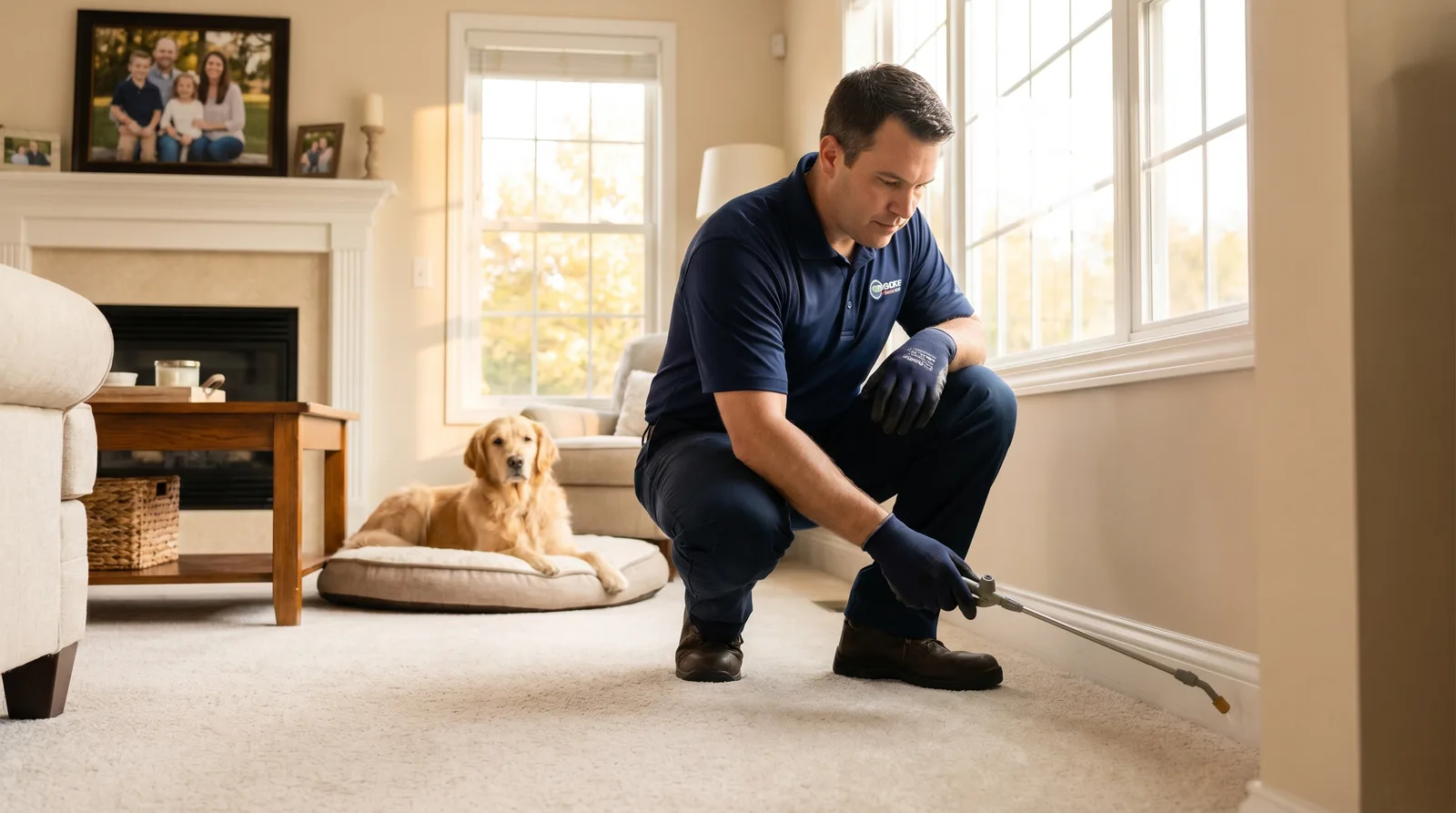
Our pet-safe flea treatment, step by step
1. Inspect and confirm. We check where fleas are concentrated — pet bedding, carpeted rooms, the spots your pets favor — and confirm it is fleas (not another biting pest) before we treat.
2. Treat the interior with an adulticide + IGR. We apply a flea product that kills adults together with an insect growth regulator that stops eggs and larvae from ever becoming biting adults. The IGR is what actually breaks the cycle, and it is the step DIY usually skips.
3. Coordinate with your pet’s vet treatment. Keep every pet on a vet-recommended flea control. We time our home treatment so the two reinforce each other instead of leaving a gap the fleas slip through.
4. Treat the yard if it is feeding the problem. If fleas are riding in from the yard, the house will keep getting re-seeded. We will recommend yard flea treatment when the outdoor reservoir is part of the picture.
5. Follow up for the pupal wave. Pupae keep hatching for weeks. We plan a follow-up so the new wave meets fresh treatment instead of a clear home — the difference between fleas gone and fleas back.
Yes — that is the whole point of a professional treatment. We use products labeled for use in homes with pets and children, applied by a licensed technician at the right rate and in the right places, and we tell you exactly how long to keep pets and kids off treated surfaces while they dry. That is safer than the guesswork of stacking store-bought sprays, foggers, and collars.
How to prep your home before we arrive
A little prep makes the treatment dramatically more effective, because it exposes the eggs and pupae hiding down in the carpet and clears a path to the edges where fleas live.
Flea treatment prep checklist
Skipping the vacuum-and-wash step is the most common reason a treatment underperforms. Eggs and pupae buried in carpet fibers need to be lifted and exposed; flea “bombs” and foggers do not reach them, and treating without prepping leaves the nursery intact. We will walk you through exactly what to do.
DIY or call a pro?
A thorough, consistent owner can win — our step-by-step DIY guide shows how. It tends to fail when the infestation keeps rebounding after weeks of effort, when the carpet and yard are heavily loaded, when several pets keep feeding the cycle, or when the bites simply will not stop. A professional coordinates pet, home, and yard with products timed to the life cycle, which clears it in fewer cycles and far less frustration.
See our full flea control →Pet-safe flea treatment FAQ
Is professional flea treatment safe for my dog, cat, and kids?
Yes. We use products labeled for homes with pets and children, applied by a licensed technician at the correct rate, and we tell you how long to keep pets and kids off treated surfaces while they dry. It is safer and more effective than stacking multiple store-bought products yourself.
If my pet is on flea medication, why do I still need my home treated?
Because most of the infestation — eggs, larvae, and pupae — is in your carpet, bedding, and floors, not on the pet. Vet flea products protect the animal, but they do not clear the home reservoir that keeps re-seeding fleas onto your pet.
Will one treatment get rid of the fleas?
Usually it takes the first treatment plus a follow-up, because pupae hatch in waves over several weeks. We time the visits to the life cycle so the new wave meets treatment instead of an empty home. Expect a short rebound before it clears — that is normal.
Do you treat the yard too?
When the yard is feeding the problem, yes — otherwise the outdoor reservoir keeps re-infesting the house. We will recommend yard flea treatment if your inspection shows fleas are concentrated outdoors as well.
How should I prepare before the treatment?
Vacuum all floors and wash pet bedding on hot before we arrive, keep pets on their vet flea product, and clear access to baseboards and pet resting areas. After treatment, hold off vacuuming for the window we give you, then vacuum daily.
Done chasing fleas around your house? Let us break the cycle.
Call (559) 472-8200 or request a no-cost inspection — pet-safe treatment for your home, timed to the flea life cycle.