
Home › Learn › Identify
What Does a Wasp Nest Look Like?
A wasp nest is built from chewed wood pulp — “paper” — and its shape tells you the species. Here’s how to recognize paper wasp, yellowjacket, hornet, and mud dauber nests, by type and by where you find them.
A wasp nest is made of chewed wood fiber that dries into a papery grey material, and its shape depends on the species. Paper wasps build an open, upside-down, umbrella-shaped comb with visible six-sided cells. Yellowjackets build a hidden papery nest underground or inside a wall. Bald-faced hornets build a large, enclosed grey “football” in a tree or high eave. Mud daubers don’t make paper at all — they build small tubes out of mud.
Open umbrella comb under an eave = paper wasp. Big enclosed grey ball in a tree or shrub = bald-faced hornet. A hole in the lawn or wall with steady wasp traffic = a hidden yellowjacket nest. Finger-sized mud tubes = a harmless mud dauber. The open eave nests are the ones you’ll see most on Fresno homes.
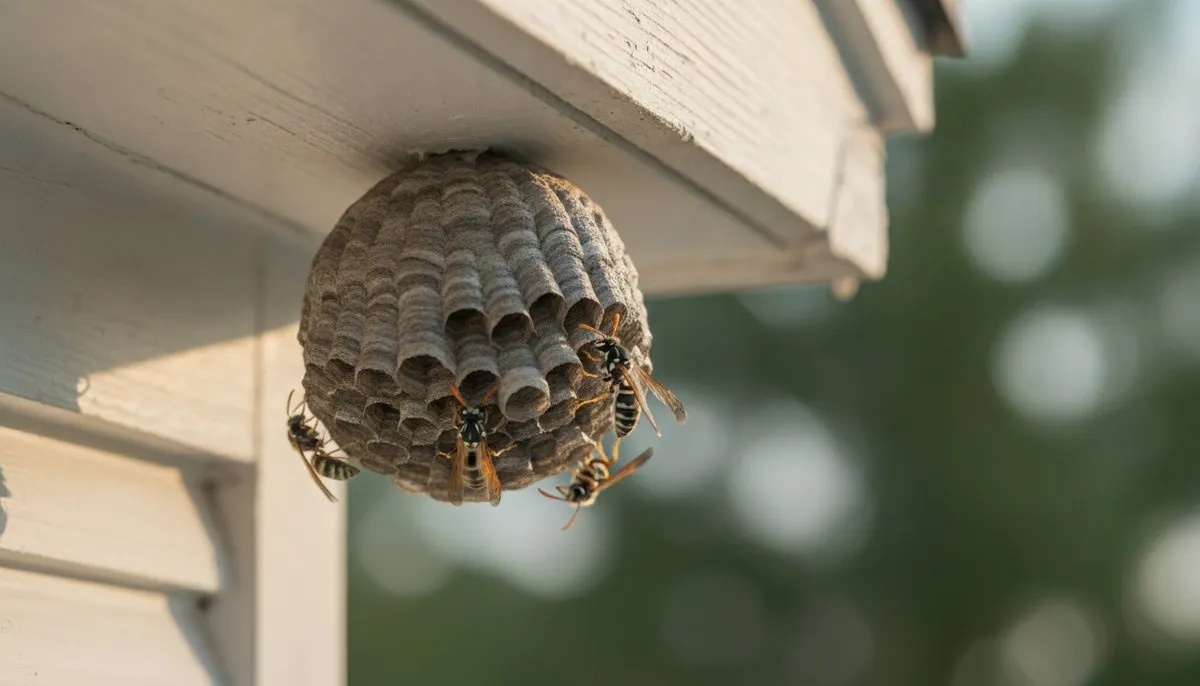
Wasp nests by type
How to identify a wasp nest by its shape
Paper wasp nest
The paper wasp nest is the one most Fresno homeowners find. It’s an open grey comb shaped like an upside-down umbrella, hanging from a single stalk, with the six-sided cells fully visible from below — there’s no outer shell. They’re usually small (a few inches across, holding a few dozen wasps) and almost always tucked under an eave, patio cover, soffit, or door frame. Because the cells are exposed, you can often see pale larvae or wasps tending the nest.
Yellowjacket nest
A yellowjacket nest is built the same papery way, but hidden — which is what makes it dangerous. Most are underground in an old rodent burrow or ground cavity, or tucked inside a wall void, with only a small opening where you’ll see a steady stream of wasps coming and going. By late summer a single nest can hold thousands. If you can’t see a nest but there’s constant wasp traffic in and out of a hole in the lawn or a gap in the stucco, that’s a yellowjacket nest — and not one to probe. Compare the species on our yellowjacket vs. wasp vs. hornet guide.
Bald-faced hornet nest
The bald-faced hornet builds the classic large, enclosed grey nest — a layered papery ball or teardrop with a single entrance hole near the bottom, often the size of a football or larger by late summer. You’ll find them hanging in a tree, tall shrub, or under a high eave. Unlike the open paper-wasp comb, this nest is fully sealed, and the hornets defend it aggressively within a few feet, so an enclosed grey ball at head height or above should be left to a professional.
Mud dauber nest
Mud dauber “nests” aren’t paper at all — they’re small tubes of dried mud, either single finger-length tubes or several side by side like a tiny pipe organ, stuck to a wall, eave, ceiling, or shed. Mud daubers are solitary and very docile; they almost never sting, and they actually hunt spiders. An old mud nest is usually empty and can simply be scraped off.
Wasp nests by location: ground, wall, attic & eaves
Where the nest is matters as much as its shape. A nest under an eave or on the porch is almost always paper wasps and is the most approachable. A nest in the ground — a hole in the lawn with traffic — is yellowjackets, and disturbing it (with a mower, for instance) is how people get swarmed. A nest in a wall void or attic shows up as wasps squeezing through a gap or appearing indoors, and needs care so the colony isn’t driven into living space. A large enclosed nest high in a tree is usually hornets.
Knocking down a nest — or spraying a ground or wall nest — often provokes the colony instead of killing it, and ground yellowjackets will swarm. Hidden wall and attic nests can also push wasps deeper into the house. If the nest is enclosed, in the ground, in a wall, or out of easy reach, it’s safer to have it removed professionally.
Wasp nest FAQ
What does a wasp nest look like?
It depends on the wasp. Paper wasps build an open, umbrella-shaped grey comb with visible cells under eaves; yellowjackets build a hidden papery nest underground or in walls; bald-faced hornets build a large enclosed grey ball in trees; and mud daubers build small mud tubes. All except mud daubers are made of chewed-wood “paper.”
What does a wasp nest in the ground look like?
You usually don’t see the nest itself — just a small hole in the lawn or a slope with a steady stream of yellowjackets flying in and out. The papery comb is hidden in a cavity below ground, often an old rodent burrow. Ground nests are best left alone and treated professionally, since disturbing one triggers a swarm.
How do I tell a wasp nest from a hornet nest?
A paper wasp nest is open — you can see the honeycomb cells. A bald-faced hornet nest is fully enclosed in a grey papery shell with one entrance hole, and it’s larger and usually higher up in a tree or eave. If you can see the cells, it’s a paper wasp; if it’s a sealed grey ball, it’s a hornet.
How do I know if a wasp nest is still active?
An active nest has steady wasp traffic in and out during the day and wasps tending the comb. An old or abandoned nest has no movement, may look weathered or torn, and stays quiet even in warm afternoon hours. Paper wasps and yellowjackets also abandon nests over winter and don’t reuse the same nest the next year.
Should I remove a wasp nest myself?
A small, clearly inactive nest you can reach may be manageable, but active yellowjacket ground nests, wall nests, and enclosed hornet nests are not DIY jobs — they swarm and sting when disturbed. If the nest is hidden, in the ground or a wall, large, or out of easy reach, have it removed professionally.
Found a nest on your property?
Call (559) 472-8200 or request a no-cost inspection — we’ll identify the nest and remove it safely, including hidden ground and wall nests.