
Home › Learn › Spiders › Brown Recluse in California
Are There Brown Recluse Spiders in California?
The short answer: no. The brown recluse is not established in California — and that brown spider in your garage is almost certainly something harmless. Here is what you actually have, and why “recluse bite” is usually the wrong answer.
No — the brown recluse (Loxosceles reclusa) is not established in California. It is native to the south-central and midwestern United States, and despite how often people in Fresno are sure they have found one, there are no breeding populations of brown recluse in the state. The brown spider in your garage, woodpile, or box of stored stuff is almost always a harmless look-alike. This is the single most common spider mix-up we see, so it is worth clearing up.
Brown recluse spiders do not live in California. Nearly every “recluse” found here is a harmless wolf spider, house spider, or sac spider, and most “recluse bites” diagnosed in the state turn out to be other skin problems. The one California spider actually worth caution is the western black widow — not the recluse.
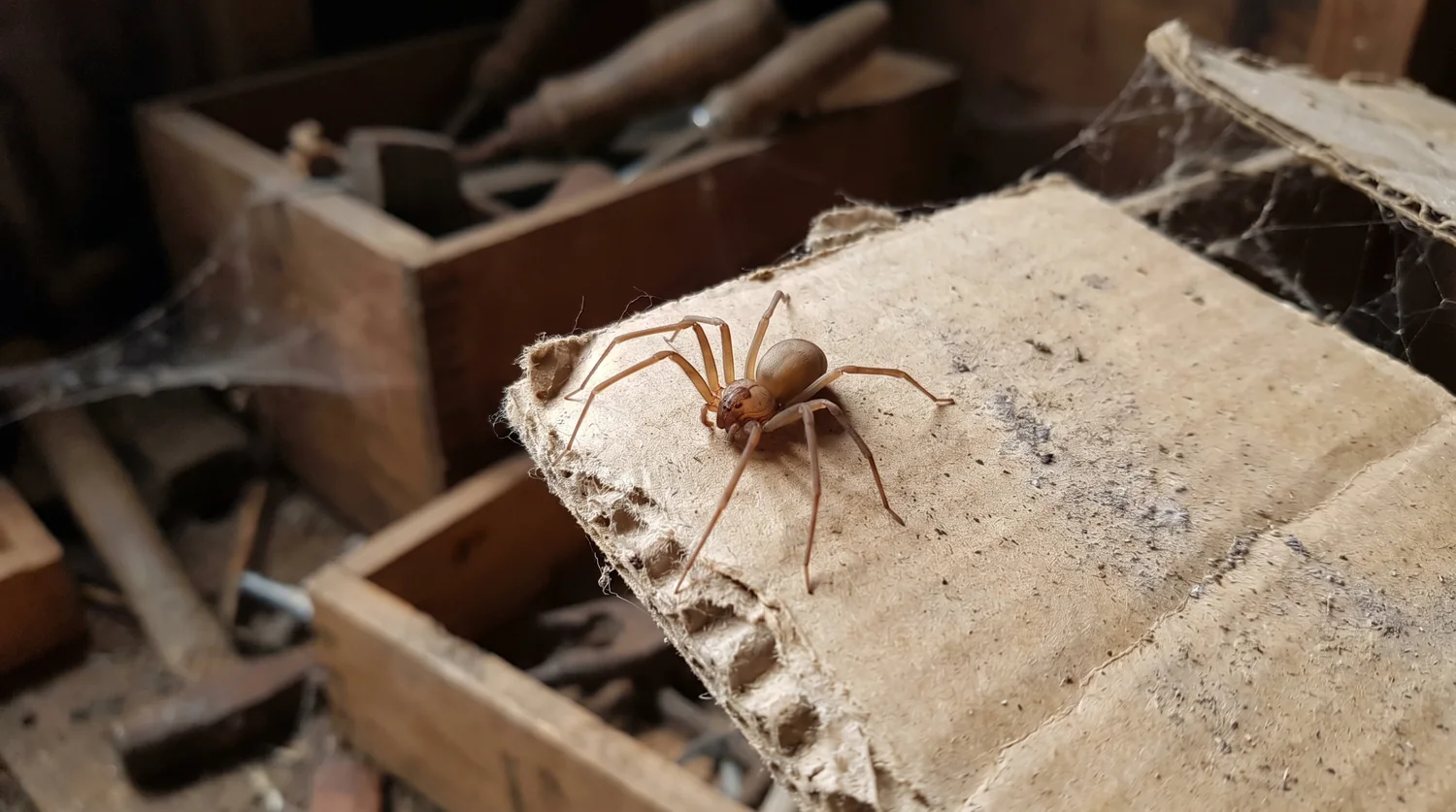
What a real brown recluse looks like
A genuine brown recluse is small (about three-eighths of an inch in the body), a uniform sandy tan, with smooth legs that have no stripes, bands, or spines. Behind the head sits a darker, violin-shaped mark with the “neck” of the violin pointing back toward the abdomen — which is why it is nicknamed the fiddleback. Its most reliable feature is something most people never check: it has six eyes arranged in three pairs, where most spiders have eight. The violin shape alone is not proof, because several harmless spiders have vague dark markings too.
Brown recluse vs. the spiders Californians actually find
What you actually found instead
Nine times out of ten, the “recluse” in a Fresno home is a wolf spider — a big, fast, brown, ground-hunting spider that wanders indoors in fall. Wolf spiders are harmless, but their size and color set off recluse alarms constantly (the question “wolf spider vs brown recluse” is one of the most-searched spider queries in the country). Other common stand-ins are the woodlouse hunter (a reddish spider that eats pill bugs), the yellow sac spider, and the brown male western black widow. The quickest tells: a recluse has no leg markings and only six eyes — if your spider is hairy, striped, or fast on the ground, it is a wolf spider, not a recluse.
Why “brown recluse bite” is usually the wrong answer
Most “recluse bites” are diagnosed without anyone ever seeing a spider. The problem is that a lot of common conditions — bacterial skin infections (including MRSA), other insect bites, and various sores — look like the necrotic wound people associate with recluses. In states where recluses do not live, study after study has found that confirmed recluse bites are vanishingly rare and that “spider bite” is a frequent misdiagnosis. UC researchers have spent years documenting this in California specifically. None of that means a bad wound should be ignored — it means “brown recluse” is almost never the cause here.
A spreading, blackening, or worsening skin wound deserves medical attention no matter what caused it — it could be an infection that needs treatment. Just do not assume it was a brown recluse, and do not let a “spider bite” label delay proper care.
The California spider that IS worth respecting
If you want to spend your spider-worry wisely, spend it on the western black widow — shiny black with a red hourglass underneath, hiding in garages, meter boxes, and woodpiles. It is the one California spider whose bite can occasionally need medical care, especially for children and older adults. Compare the two head-to-head in our black widow vs. brown recluse guide, or see the UC Riverside spider research site for the science behind the recluse myth.
Worried about black widows? See our spider control →Brown recluse in California FAQ
Are there brown recluse spiders in California?
No. The brown recluse is not established in California. Rare individuals are occasionally transported in from other states in boxes or furniture, but there are no breeding populations, and the average resident will never encounter one.
What spider looks like a brown recluse in California?
Most often a wolf spider — a large, fast, brown, ground-hunting spider. Woodlouse hunters, yellow sac spiders, and male black widows are also mistaken for recluses. None of them is a brown recluse, and the quickest tells are leg markings and eye count.
Is a wolf spider a brown recluse?
No. Wolf spiders are harmless and are the spider most often mistaken for a brown recluse. A wolf spider is hairy with striped, spiny legs and eight eyes; a recluse has smooth unmarked legs and six eyes — and does not live in California.
Has anyone in California been bitten by a brown recluse?
Verified brown recluse bites in California are extremely rare and nearly always trace back to a spider transported from out of state. Most “recluse bites” diagnosed here are actually skin infections or other conditions, not spider bites at all.
What should I do about a wound I think is a spider bite?
See a doctor if it is spreading, worsening, or not healing — it may be an infection that needs treatment. Just do not assume it was a brown recluse, since they are not found in California.
Found a brown spider you can’t identify?
Call (559) 472-8200 or request a no-cost inspection. We will tell you what it actually is — and handle black widows if you have them.