
Home › Learn › Roof Rats in California
Roof Rats in California: ID, Signs & How to Get Rid of Them
Roof rats are the most common rat in California — agile climbers that nest in attics, fruit trees, and rooflines across the Central Valley. Here’s how to identify them, the signs to watch for, and what actually works.
Roof rats (Rattus rattus) are the most common rat in California (per UC IPM) — including here in Fresno and across the Central Valley. They’re lean, dark, expert climbers that prefer to live above ground: in attics, rafters, fruit and citrus trees, palms, and along rooflines and utility lines. If you’re hearing scratching overhead at night or finding gnawed fruit in the yard, roof rats are the most likely culprit.
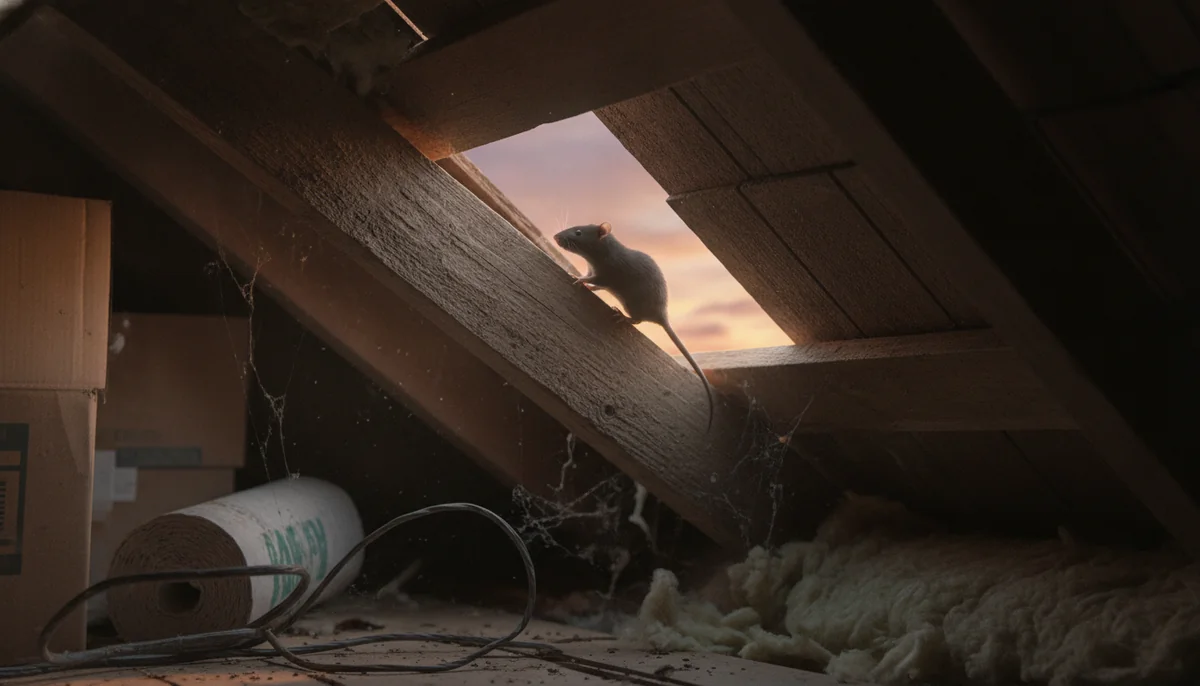
How to identify a roof rat
A roof rat has a 5–7 inch body with a tail that is longer than its body, dark grey to black fur with a paler belly, a pointed nose, and large ears and eyes relative to its head. Adults weigh about 5–9 ounces. Next to the Norway rat, the roof rat is noticeably sleeker, lighter, and more agile.
Roof rat vs Norway rat
Not sure it’s even a rat? Compare it against the house mouse in our mouse vs rat guide, or see all the types of rats in California.
Where roof rats live in Fresno
Indoors, roof rats nest high — attics, rafters, soffits, wall voids, and garages. Outdoors, they love citrus, fig, persimmon, almond and other fruit and nut trees, grapevines, ivy, palm skirts, and woodpiles. They travel along fences, power lines, and any tree limb that touches the roof. Fresno’s mature trees and fruit belt give them ready-made highways straight onto the house — which is why we find them in attics all over the area.

Signs of roof rats
• Scratching or scurrying in the attic or walls at night — roof rats are nocturnal.
• Droppings about a half-inch long with pointed ends, in the attic, garage, or along beams.
• Gnaw marks on wood, wiring, and stored items.
• Grease or rub marks — dark smudges from their oily fur along beams and entry holes.
• Gnawed fruit on the tree or on the ground.
• Nests of shredded material in the attic — see what a rat nest looks like.
• A pet fixated on a wall or ceiling.
Roof rats gnaw constantly — including on electrical wiring, a recognized fire risk. They also contaminate insulation and stored food and can carry disease, and they breed fast, so a small problem grows quickly.
Are roof rats dangerous?
Yes, in three ways: disease — they can carry and transmit pathogens and parasites (see the CDC on rodent-borne disease); property damage and fire risk from gnawing wiring; and contamination of food and insulation with droppings and urine. Because they reproduce quickly, prompt removal matters.
How to get rid of roof rats
Because roof rats live high and travel the roofline, the fix is exclusion-first: find and seal every entry point (rooflines, vents, pipe gaps, eaves), trim tree limbs and vines off the house, remove fallen fruit and other food, then trap the rats already inside. Broadcast bait alone doesn’t solve a roof-rat problem and creates secondary-poisoning risk for pets and raptors (see the EPA on rodenticides). See our rat control, rodent exclusion, and attic restoration services.
Get rid of roof rats — see rodent controlRoof rats — FAQ
Are roof rats common in California?
Yes — roof rats are the most common rat in California, including the Fresno area and the rest of the Central Valley. They are better suited to the state’s warm, dry climate than Norway rats.
What is the difference between a roof rat and a Norway rat?
Roof rats are slender, dark, excellent climbers with a tail longer than their body, and they live high — attics and trees. Norway rats are heavier and brown, with a tail shorter than their body, and they burrow at ground level.
Where do roof rats nest?
Up high — attics, rafters, wall voids, and soffits indoors; fruit and citrus trees, palms, ivy, and woodpiles outdoors.
Are roof rats dangerous to humans?
They can carry disease, contaminate food and insulation, and gnaw electrical wiring, which is a fire risk. It is best to remove them promptly and clean up any contamination safely.
How do I get rid of roof rats?
Seal entry points along the roofline, trim trees and vines off the house, remove food sources like fallen fruit, and trap the rats inside. Exclusion plus trapping works far better than bait alone.
Roof rats in your attic or trees?
We find how they’re getting in, seal it, and clear them out — exclusion-first rodent control for Fresno and the Central Valley. Book a no-cost inspection.