
Home › Learn › Identify
Cicada Killer Wasps: The Giant Wasps in Your Yard
Cicada killers are the huge wasps that alarm Central Valley homeowners every summer. Here’s how to identify them, why they’re digging in your lawn, and whether the giant wasp you’re seeing is actually dangerous.
Cicada killers are large solitary wasps — up to about two inches long — that dig burrows in bare, sunny soil and hunt cicadas to feed their young. Despite their alarming size, they’re mostly harmless to people: the males can’t sting at all, and the females almost never do unless you grab one. The giant wasp cruising low over your lawn in July is far more frightening than it is dangerous.
A giant wasp digging in bare, sunny soil in mid-to-late summer is almost always a cicada killer — solitary, docile, and not worth panicking over. The real danger look-alike is a ground-nesting yellowjacket, which is much smaller, lives in a shared colony, and is aggressive. The size is the tell: cicada killers are huge; yellowjackets are about a half-inch.
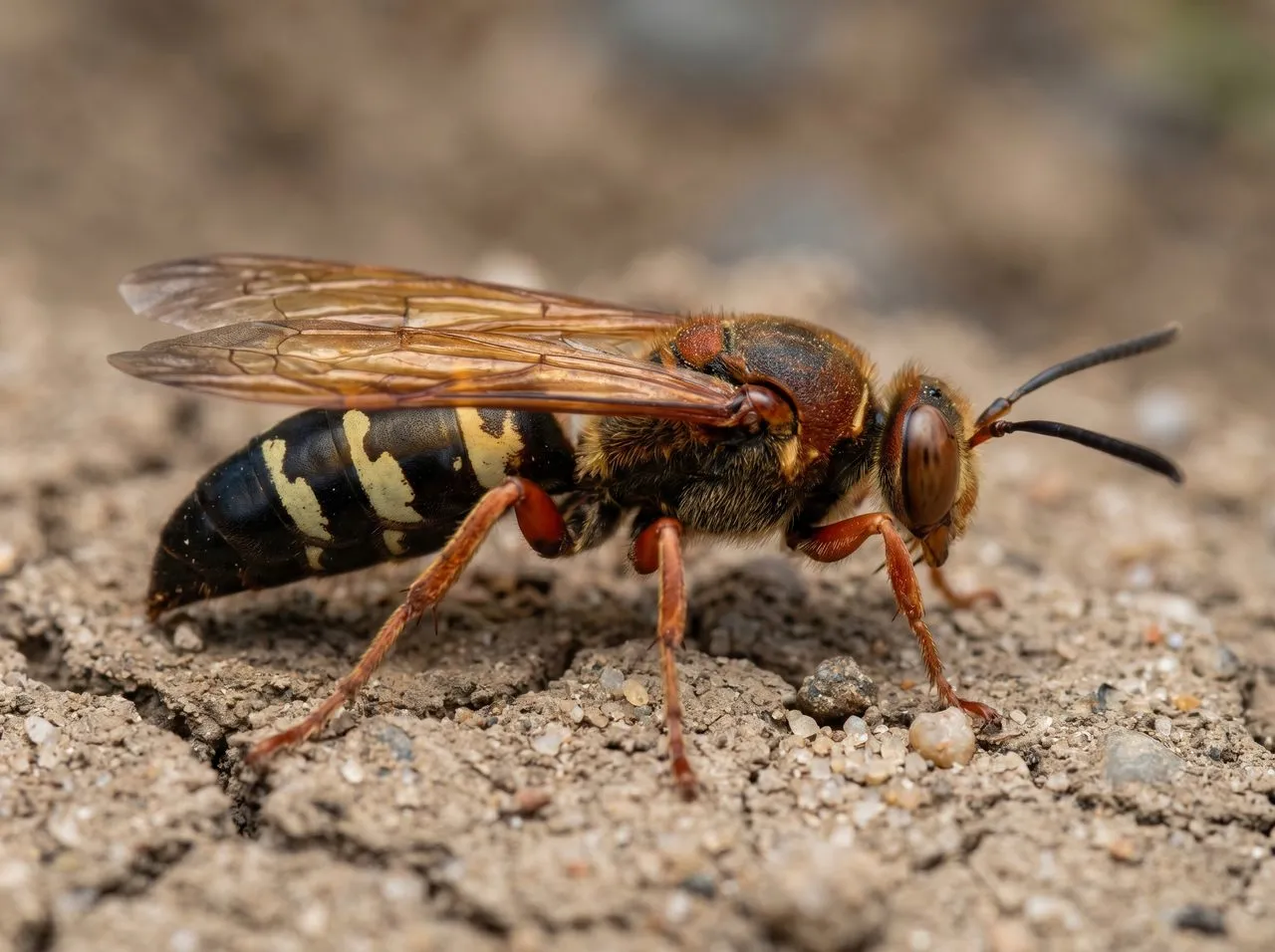
What a cicada killer looks like
Cicada killers are among the largest wasps in North America. They have a rusty reddish-brown and black thorax, a black abdomen marked with broken pale-yellow bands, amber-tinted wings, and reddish legs. At up to two inches, a cicada killer dwarfs a yellowjacket or paper wasp — the size alone usually gives it away. You’ll see them flying low over lawns and bare ground from roughly July through September, often carrying a paralyzed cicada back to a burrow.
Are cicada killers dangerous? Do they sting?
Not really. Male cicada killers are territorial and will hover, dart, and even bump into you near their burrows — but males have no stinger and can’t hurt you. Females do have a stinger (they use it to paralyze cicadas), but they’re not defensive of their burrows the way social wasps are, and they sting people only if grabbed or stepped on barefoot. There’s no colony to defend, so they don’t swarm. For nearly everyone, cicada killers are a nuisance, not a threat.
Why cicada killers are digging in your lawn
Each female digs her own burrow in loose, bare, sun-baked soil — thin lawns, flowerbeds, the edges of driveways and sidewalks, sandy patches — leaving a tell-tale fan or mound of excavated dirt at the entrance. They prefer spots with sparse grass and good drainage, which is why a struggling lawn or a sunny dirt strip attracts them. They’re solitary, so you may see many individual burrows in a good patch, but it’s not one shared colony.
Cicada killer or ground-nesting yellowjacket? (the important difference)
This is the distinction that matters for your safety. A cicada killer is giant and harmless; a ground-nesting yellowjacket is small but aggressive and will swarm if you mow over or disturb the nest. Use the size and the traffic at the hole to tell them apart:
Cicada killer vs. ground-nesting yellowjacket
If the hole has a steady stream of small, brightly banded wasps coming and going, treat it as yellowjackets and keep your distance — see yellowjacket vs. wasp vs. hornet. If it’s one oversized wasp per burrow, it’s a cicada killer.
Should you get rid of cicada killers?
Usually not — they’re harmless and disappear on their own by early fall when the adults die off. The best long-term fix is to remove what attracts them: thicken thin or bare lawn areas, since dense turf gives them nowhere to dig. Treatment is only worth it when there are so many burrows they’re damaging a lawn or digging right next to a doorway, patio, or play area where the constant dive-bombing is unbearable. In those cases we can treat the burrows directly.
Because a harmless cicada killer and a dangerous ground yellowjacket both nest in soil, it’s not worth guessing if you’re about to mow, dig, or let kids play nearby. If you can’t clearly see that it’s one giant solitary wasp per hole, have it identified before you disturb the ground.
Cicada killer FAQ
Are cicada killer wasps dangerous to humans?
Not really. Male cicada killers have no stinger and can’t hurt you, and females only sting if grabbed or stepped on. They have no colony to defend, so they don’t swarm. They look frightening because of their size, but they’re one of the more harmless large wasps you’ll meet.
Do cicada killers sting?
Females can sting — they use the stinger to paralyze cicadas — but they’re not aggressive toward people and rarely sting unless handled. Males, which do most of the hovering and dive-bombing near burrows, have no stinger at all.
How big are cicada killer wasps?
They’re among the largest wasps in North America, reaching up to about two inches long. That size is the easiest way to tell a cicada killer from a yellowjacket or paper wasp, which are only about a half-inch.
How do I get rid of cicada killers in my lawn?
The lasting fix is to thicken thin, bare, or sandy lawn areas, since cicada killers dig only in sparse, sun-baked soil — dense turf removes the habitat. Direct burrow treatment is worth it only when there are many burrows damaging the lawn or right by a door, patio, or play area.
What’s the difference between a cicada killer and a yellowjacket?
Size and lifestyle. Cicada killers are giant (up to 2 inches) and solitary, each female digging her own burrow, and they’re harmless. Ground-nesting yellowjackets are small (about ½ inch), live in a shared colony of hundreds to thousands, and are aggressive — the dangerous one of the two.
A ground nest you can’t identify?
Call (559) 472-8200 or request a no-cost inspection — we’ll tell a harmless cicada killer from a dangerous yellowjacket nest and treat it if needed.