
Home › Learn › Signs of Mice in Your House
Signs of Mice in Your House (and Signs of Rats)
Droppings, gnaw marks, scratching at night, a musky smell, and chewed food packaging are the top signs of mice. Here’s the full checklist for mice and rats, where to look, and what to do.
The most common signs of mice in a house are small dark droppings, gnaw marks on food packaging, scratching or scurrying in walls at night, a musky smell, and shredded-material nests. Mice are small and secretive, so you’ll usually notice the evidence before you see the mouse. Catch the signs early — a couple of mice become an infestation fast.
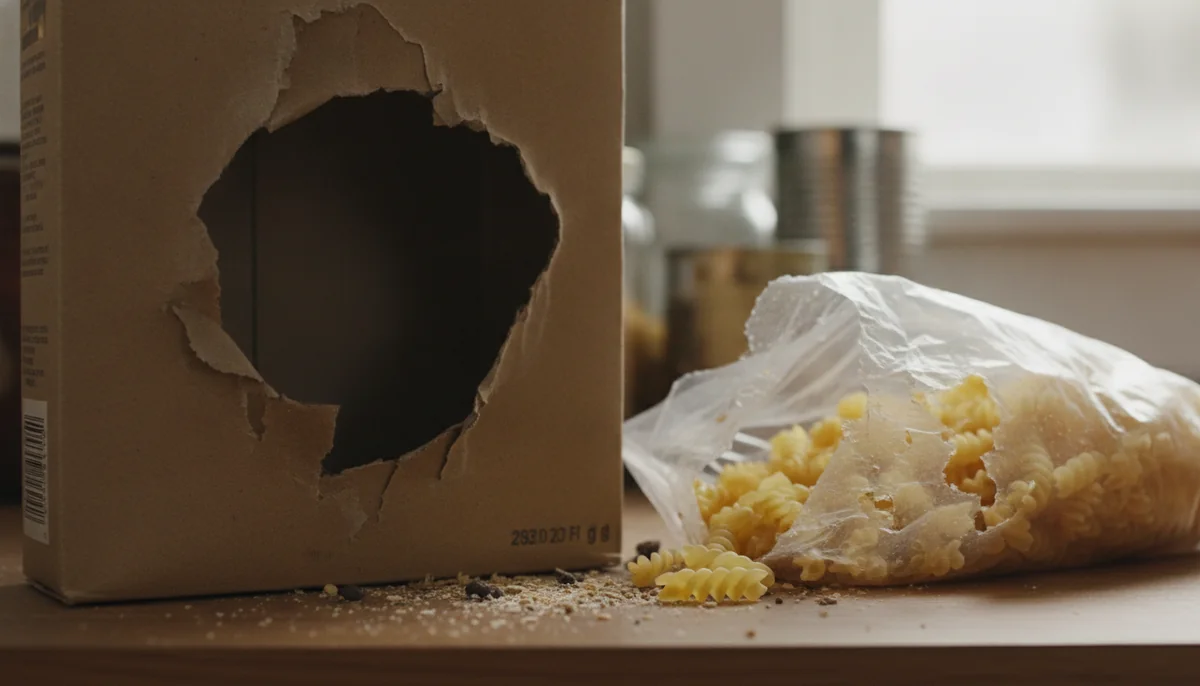
Signs of mice — the checklist
✔ Droppings — small, dark, rice-grain pellets along walls, in drawers and cupboards, and behind appliances.
✔ Gnaw marks — chewed food packaging, cardboard, and small holes; mice gnaw constantly.
✔ Scratching or scurrying in walls, ceilings, or under floors, usually at night.
✔ A musky, ammonia-like smell in enclosed spaces.
✔ Nests — balls of shredded paper, fabric, or insulation behind appliances or in storage.
✔ Grease or rub marks — faint smudges along baseboards and runways.
✔ Chewed or scattered food, especially pet food and pantry items.
✔ Your pet fixating on a wall, appliance, or cabinet.
Mouse signs vs rat signs
How mouse and rat signs differ

Where to look
Start where food and warmth meet shelter: the kitchen (behind and under the stove and fridge, inside lower cabinets, the pantry), the garage (stored boxes, pet food, the water-heater closet), the attic (insulation and along beams — more likely rats), and utility areas (behind the washer and dryer, around pipe penetrations).
How fast does it become an infestation?
Fast. A female mouse can have 5–10 litters a year, with 5–6 pups each, and they mature in weeks. That’s why two mice in spring can be dozens by fall. Rats breed a little slower, but the same principle holds — early action is far easier than a full infestation.
Mostly no — mice are nocturnal, so a daytime sighting often means a larger population or that they’ve been disturbed. Either way, seeing one in daylight is worth acting on.
What to do
Confirm the signs, clean up droppings safely (don’t sweep dry — see the droppings guide), remove food sources, and seal entry points. If signs keep appearing, have it inspected. See mouse control and rodent exclusion.
See rodent control in FresnoSigns of mice — FAQ
How do I know if I have mice?
Look for small dark droppings, gnaw marks on packaging, scratching in walls at night, a musky smell, and shredded nests. The droppings and gnaw marks are usually the first signs.
What are the first signs of mice?
Usually droppings near food and along walls, plus gnaw marks on food packaging and faint scratching sounds at night.
Do mice come out during the day?
Mice are mainly nocturnal, so seeing one during the day often signals a larger population or that the nest was disturbed.
Do mice bite?
Rarely — mice avoid people and bites are uncommon, usually only if a mouse is cornered or handled. The bigger concern is disease from droppings and urine.
How can I tell mice from rats in my house?
Droppings size and sounds. Tiny droppings and light scratching point to mice; large droppings and heavier noises in the attic point to rats.
Seeing the signs of mice?
We’ll confirm it, find the entry points, and clear them out before a couple of mice become an infestation. Book a no-cost inspection in Fresno.