
Home › Mosquitoes › Abatement District vs Private Service
Fresno Mosquito Abatement District vs. a Private Mosquito Service
The public abatement district protects your community and watches for West Nile virus; a private service treats your individual yard on a schedule. Here is what each one does — and how to use both.
Fresno's public mosquito abatement districts and a private mosquito service do two different jobs — the district reduces mosquitoes across public areas and watches for West Nile virus, while a private service treats your individual yard on a recurring schedule. Both the Fresno Mosquito and Vector Control District (FMVCD) and the Consolidated Mosquito Abatement District (CMAD) are tax-funded public agencies that survey for mosquitoes, treat standing water on public land, provide no-cost mosquitofish, inspect properties for breeding sources at no charge, and monitor for disease. What they do not provide is scheduled, recurring barrier treatment of your own backyard — and that is exactly the gap a private company like Total Pest Control Fresno fills.
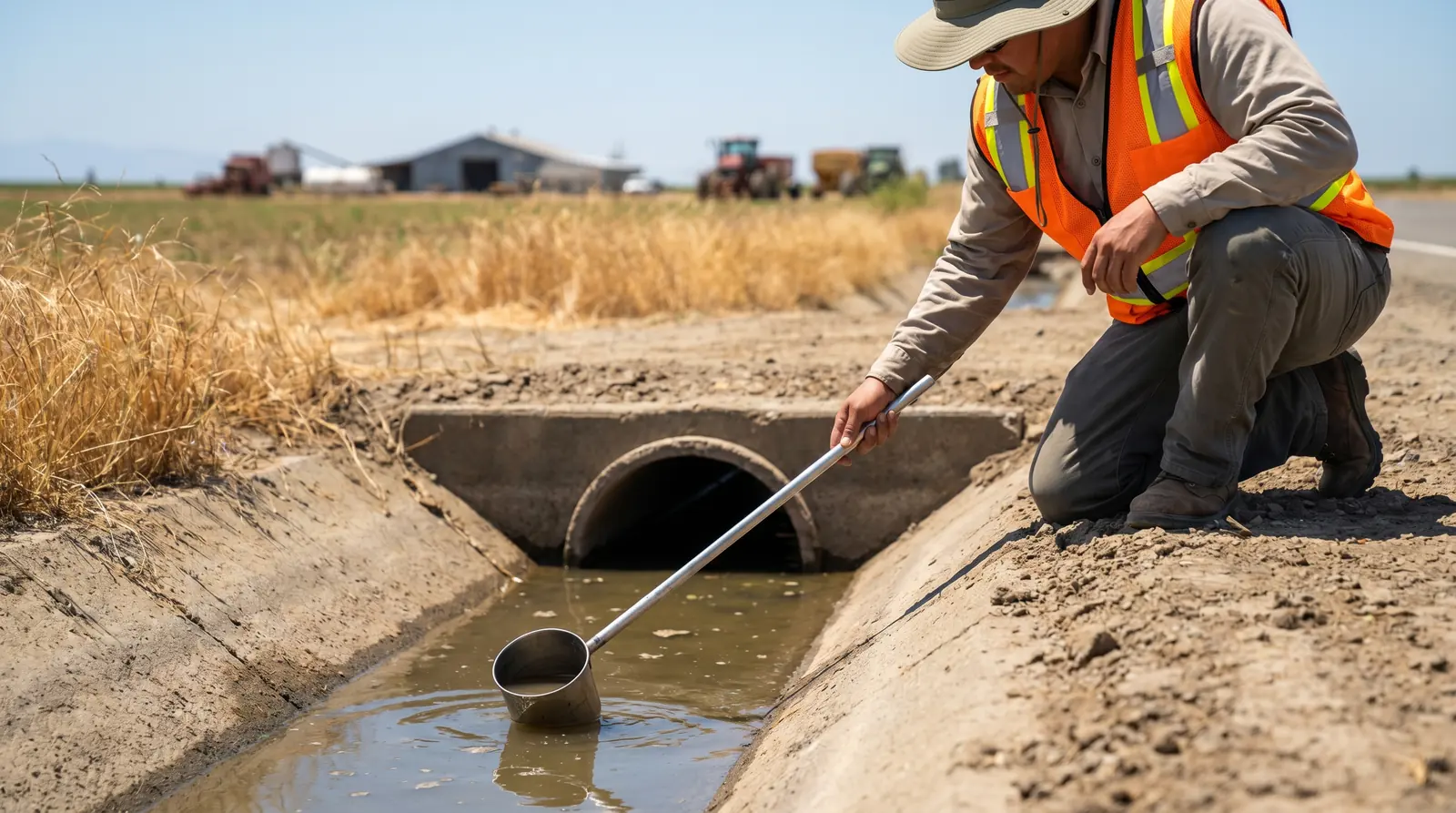
Who covers your address: FMVCD or Consolidated MAD?
Your Fresno-area address is served by one specific public mosquito district — most often the Fresno Mosquito and Vector Control District or the larger Consolidated Mosquito Abatement District. FMVCD (fresnomosquito.org) covers part of the City of Fresno and nearby communities such as Kerman, Biola, Calwa, Malaga and Easton. Consolidated MAD (consolidatedmadca.gov) is the larger district, covering central and eastern Fresno County including Clovis, Fowler, Kingsburg, Parlier, Reedley, Orange Cove, Sanger, Selma and a portion of the City of Fresno.
An important detail many residents get wrong: Clovis is served by Consolidated, not by FMVCD. Because the City of Fresno itself is split between districts, the simplest way to know which one serves you is to call either office — they will tell you immediately.
What the mosquito abatement district actually does
A mosquito abatement district is a tax-funded public agency that controls mosquitoes across an entire region and tracks mosquito-borne disease — work no private company does. Both districts perform the same core categories of work, paid for by property taxes, so there is no charge to residents:
Surveillance & trapping — they set traps to monitor which mosquito species are present and where populations are building.
Public-area source control — they treat standing-water breeding sources and apply larvicide on public land, including wide-area larvicide spraying.
No-cost breeding-source inspection — you can request an inspection and a technician will check your property for standing water at no cost, a genuinely useful service most homeowners never use.
No-cost mosquitofish — both districts provide mosquitofish at no cost for ornamental ponds, troughs and neglected pools, where the fish eat mosquito larvae.
Green / neglected-pool response — they take reports of abandoned “green” swimming pools, a major breeding source, and treat or stock them.
West Nile virus monitoring — they test trapped mosquitoes for West Nile virus and, when disease risk or extremely high adult numbers are detected, conduct area-wide fogging.
The gap: districts do area-wide work, not scheduled treatment of your backyard
The one thing the abatement district does not do is treat your individual backyard on a recurring schedule — its adult-mosquito control is reactive and area-wide, not a routine residential service. The districts focus on surveillance, public-land source reduction, mosquitofish, neglected-pool response and disease monitoring. Their fogging is triggered by disease risk or extremely high mosquito numbers across an area, so it is not something you can schedule for your own yard or rely on for everyday biting relief. That is the deliberate dividing line: the district protects the public and watches for outbreaks, while keeping your specific yard comfortable week to week is left to you — which is exactly where a private mosquito service comes in. This is not a knock on the districts; their public-health work is essential and well worth using.
How to report standing water or request a no-cost district inspection
To report standing water or request a no-cost mosquito inspection, call the district that covers your address and describe the location and problem. It is a real, useful service — here is how to use it.
1. Find your district. City of Fresno and nearby communities are usually FMVCD; Clovis, Selma, Sanger, Reedley, Fowler, Kingsburg, Parlier and Orange Cove are Consolidated. If unsure, call either office.
2. Call the district directly. FMVCD at (559) 268-6565, or Consolidated MAD at (559) 896-1085 or (800) 821-1577.
3. Report the issue. A neglected or “green” swimming pool, a roadside ditch or storm drain holding water, a vacant property with standing water, or heavy mosquito activity in your neighborhood.
4. Ask for what you need. A property inspection for breeding sources, mosquitofish for a pond or trough, or a service request for a problem area — all provided at no cost because the districts are tax-funded.
Why your backyard still needs a private mosquito service
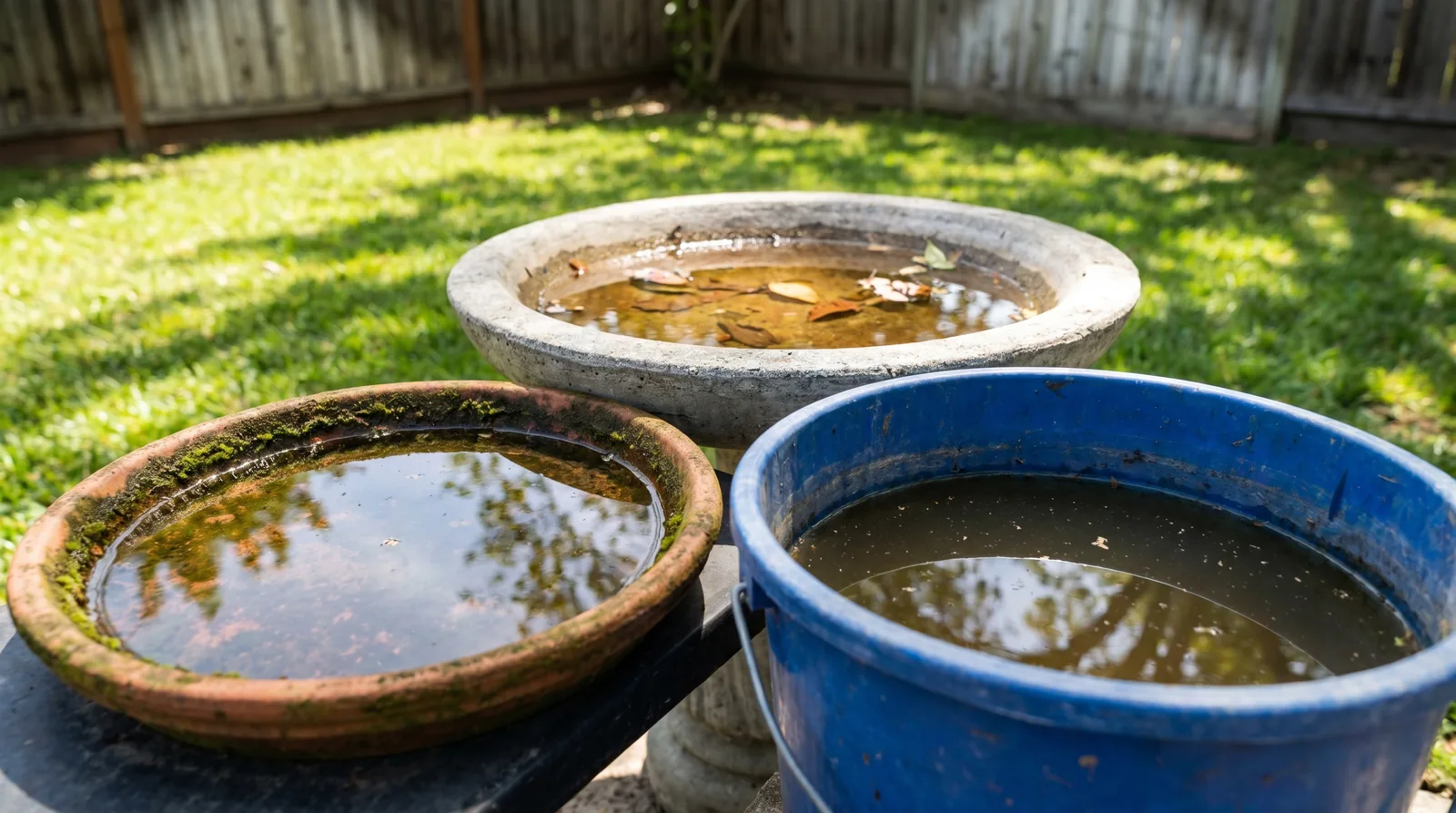
Even with an active abatement district, your own yard usually still needs private treatment, because the district will not be applying recurring barrier control to your specific property. The district works at the scale of a city or county — it cannot put a technician in every backyard every few weeks. Meanwhile the mosquitoes biting you on your own patio often breed right in your landscape: plant saucers, clogged gutters, leaky irrigation, dog dishes, birdbaths and low spots that hold water. The invasive Aedes aegypti “ankle-biter” — an aggressive daytime biter first detected in California in Madera and Clovis in 2013 and now established in Fresno County — needs only about a teaspoon of standing water to breed. And the risk is real: West Nile virus is detected in Fresno County mosquitoes essentially every season, with native Culex mosquitoes as the primary local vectors.
Our two-step yard program: EcoVenger ER-3 barrier + source reduction
Total Pest Control Fresno protects your specific yard with a two-step program: a barrier treatment that knocks down adult mosquitoes, plus source reduction that stops new ones from hatching — the part the district isn't built to do for your property.
Step 1 — Adult barrier treatment. We treat the shaded, resting vegetation where adult mosquitoes wait out the day (the undersides of leaves, dense shrubs, fence lines and ground cover) using EcoVenger ER-3, a plant-based (botanical) professional product made with geraniol, cedarwood oil and lemongrass oil rather than a synthetic pyrethroid. A botanical barrier is a sensible fit for yards with kids, pets and outdoor dining; the honest trade-off is that botanical contact products generally give a shorter residual than conventional sprays, which is one reason we pair the barrier with a recurring schedule and the second step.
Step 2 — Larval source reduction. We walk your property to find and treat the standing water where mosquitoes actually breed (the same saucers, gutters, drains and low spots the district encourages you to eliminate) so new mosquitoes never hatch in the first place. Hitting both the adults and their breeding sites is why we call it two-step, and it is how a yard stays comfortable through the season rather than for a day after a single spray.
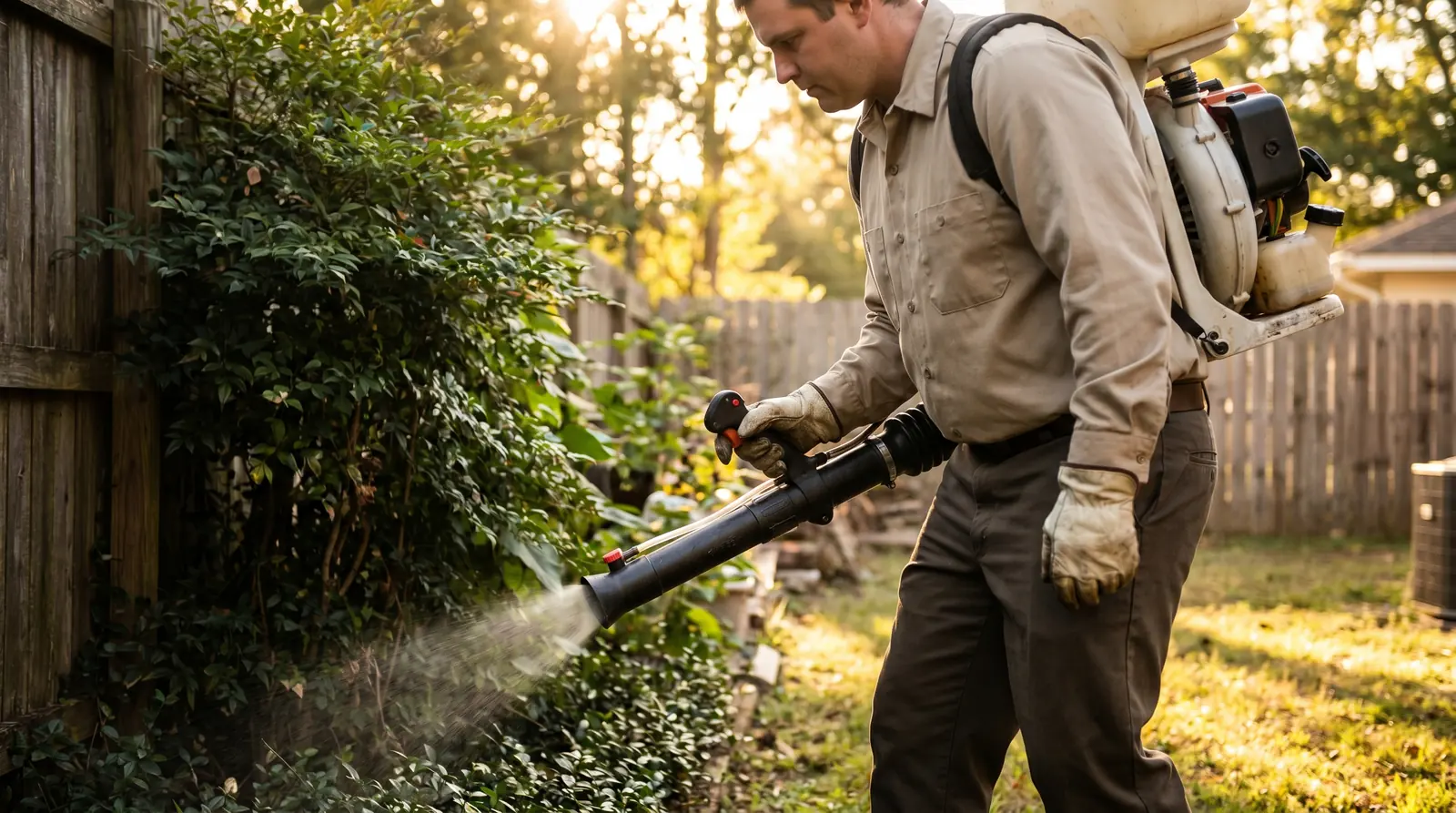
How our method differs from In2Care station services
Our two-step program treats adults and breeding sites directly, rather than relying on a passive station and a wait. Many mosquito companies use the In2Care Mosquito Station, a passive “lure-and-contaminate” device: an egg-laying female enters the station, picks up a larvicide (pyriproxyfen) and a fungus (Beauveria bassiana) on her body, then spreads the larvicide to other breeding sites before dying within roughly 6 to 12 days. It is a legitimate technology with a real strength — it can reach small, hidden water a technician can't physically find. But it is honestly a slower, conditional tool: the manufacturer itself says a significant population impact takes about three to four weeks, independent field studies show partial suppression rather than elimination, and results depend heavily on station density and on mosquitoes actually finding the stations. We chose a different approach — a botanical barrier that targets the adults already resting in your landscape, combined with hands-on source reduction of your standing water. Both approaches have a place; ours is built for homeowners who want their yard treated and the breeding water dealt with directly.
District vs. private mosquito service: side by side
Want the rest of your options? See our Fresno mosquito control overview, our backyard mosquito treatment, misting systems, and what mosquito control costs.
Fresno mosquito abatement district FAQ
What does the Fresno mosquito abatement district do?
The Fresno-area mosquito abatement districts (the Fresno Mosquito and Vector Control District and the Consolidated Mosquito Abatement District) are tax-funded public agencies that survey for mosquitoes, treat standing-water breeding sources on public land, provide no-cost mosquitofish, inspect properties for breeding sources at no charge, respond to neglected green pools, and monitor mosquitoes for West Nile virus. They do not provide scheduled, recurring barrier treatment of an individual backyard, which is what a private mosquito company provides.
Does the abatement district spray my backyard for mosquitoes?
No, not as a routine, scheduled service. The districts' adult-mosquito spraying (fogging) is reactive and area-wide, triggered by disease risk or extremely high mosquito numbers across a region, not a treatment you can schedule for your own yard. For recurring protection of your specific property, you need a private mosquito service.
Which district covers Clovis, FMVCD or Consolidated?
Clovis is served by the Consolidated Mosquito Abatement District (CMAD), not the Fresno Mosquito and Vector Control District. Consolidated covers central and eastern Fresno County, including Clovis, Fowler, Kingsburg, Parlier, Reedley, Orange Cove, Sanger, Selma and a portion of the City of Fresno. You can reach Consolidated at (559) 896-1085 or (800) 821-1577.
How do I report standing water or request a mosquito inspection in Fresno?
Call the district that covers your address and describe the location and problem. The Fresno Mosquito and Vector Control District is (559) 268-6565; the Consolidated Mosquito Abatement District is (559) 896-1085 or (800) 821-1577. You can report a neglected green pool, a ditch or vacant lot holding water, or heavy neighborhood mosquito activity, and request a breeding-source inspection or no-cost mosquitofish. If you are not sure which district serves you, call either office and they will tell you.
If my city has a mosquito abatement district, do I still need a private mosquito service?
Usually yes, if you want your own yard comfortable. The district works at the scale of a city or county and is not set up to treat individual backyards on a recurring schedule, yet many of the mosquitoes biting you breed right in your landscape, and the invasive Aedes aegypti needs only about a teaspoon of standing water to breed. A private service treats your yard on a schedule the district does not provide. The two work together: the district handles public areas and disease monitoring, the private service handles your property.
How is Total Pest Control's mosquito service different from the abatement district?
The district provides public-health and area-wide work (surveillance, public-land source control, mosquitofish, neglected-pool response and West Nile virus monitoring) at no charge to residents. Total Pest Control Fresno treats your individual yard on a recurring schedule with a two-step program: an EcoVenger ER-3 botanical barrier treatment of the resting vegetation where adult mosquitoes hide, plus hands-on source reduction of the standing water on your property where they breed. They complement each other; one does not replace the other.
What is in the EcoVenger ER-3 product you use?
EcoVenger ER-3 is a plant-based (botanical) professional mosquito product whose listed active ingredients are geraniol, cedarwood oil and lemongrass oil rather than a synthetic pyrethroid. Because plant-oil products in this class are treated as lower-toxicity, it is a sensible fit for yards with children, pets and outdoor dining. The honest trade-off is that botanical contact products generally have a shorter residual than conventional sprays, which is why we pair the barrier with a recurring schedule and with direct standing-water source reduction.
Protect your yard while the district protects the neighborhood
Use the abatement district for what it does best — report standing water, request a no-cost inspection, and pick up mosquitofish — and let Total Pest Control Fresno handle the recurring backyard protection it isn't set up to provide. We're a family-owned Fresno company serving Fresno, Clovis, Madera and Fresno County. Call (559) 472-8200 or request your quote online and we'll build a plan for your property.