
Home › Learn › Mosquito Season in California
Mosquito Season in California: When It Starts, Peaks & Ends in Fresno
In California's Central Valley, mosquito season runs roughly April through October, peaking in summer. Here is the month-by-month timeline, when West Nile risk peaks, and exactly when to start and stop treating your yard.
In California's Central Valley, mosquito season runs roughly from mid-April through October, with peak biting and disease risk in the hot summer months of about June through September. Fresno County sits in one of the state's longest and most intense mosquito windows because the Valley's flat ground, relentless summer heat and heavy agricultural irrigation give mosquitoes ideal habitat and let them complete a full generation in as little as a week. That is why “Fresno's long mosquito season” is not marketing language — it is a real, climate-driven stretch of six-plus months when an untreated yard can stay buggy from spring into fall. (Specific start and stop dates shift a few weeks every year with temperature, so treat April–October as the planning window, not a fixed calendar.)

Season window: roughly April through October in the Central Valley. Peak activity and disease risk: about June through September (West Nile risk peaks July–October). Why it's long: Valley heat plus irrigation — the egg-to-adult cycle can finish in a week or less in summer. Two threats: native Culex mosquitoes (West Nile vectors, active mostly early morning and evening) and the invasive Aedes aegypti “ankle-biter” (an aggressive daytime biter established in Fresno County). Best time to start treatment: early spring, around April, ahead of the peak. When to ease off: late fall, around October, though standing water deserves attention year-round.
When does mosquito season start in California?
Mosquito season in the Central Valley typically begins in mid-April, as spring temperatures warm standing water and overwintering mosquitoes become active. Local Fresno-area coverage consistently describes the season as starting in April and continuing through the warmer months, which is why April is the practical month to begin prevention before populations build. There is no single official start date — the exact onset moves with the weather, and warmer-than-usual springs can push activity earlier. The takeaway for a Fresno homeowner: don't wait until you're being bitten in July. By the time mosquitoes are a nuisance, several generations have already hatched, so the smartest move is to begin source reduction and treatment in early spring while numbers are still low.
Why Fresno's mosquito season is so long and intense
The Central Valley has one of California's longest and most intense mosquito seasons because its flat topography, extensive agricultural irrigation and reliable summer heat create textbook breeding habitat. Standing water from irrigation, canals and low-lying ground gives mosquitoes endless places to lay eggs, while the Valley's heat acts like an accelerator: in summer, the entire egg-to-adult life cycle can complete in a week or less depending on water temperature. That means a single warm week can turn a forgotten bucket or clogged gutter into a swarm, and overlapping generations keep populations replenished all season long. The same conditions make the Valley a historically high-risk region for mosquito-borne disease — the flat, irrigated landscape is ideal habitat for Culex tarsalis, the primary West Nile virus vector. Compared with cooler coastal areas, Fresno's combination of heat and water simply gives mosquitoes more time, more sites and more speed, which is exactly why a one-time spray rarely holds and recurring, source-focused control works better here.
Central Valley mosquito season calendar: month by month
Use this as a planning calendar, not a fixed schedule — actual timing shifts a few weeks each year with temperature.
Culex vs. Aedes: two very different mosquitoes share the season
Two very different mosquitoes are active during Fresno's season: the native Culex, which carries West Nile virus, and the invasive Aedes aegypti “ankle-biter,” an aggressive daytime biter now established in Fresno County. Knowing which is which changes when and how you protect yourself.
Native Culex mosquitoes (Culex tarsalis and Culex pipiens) are the Valley's principal West Nile virus vectors. They are most active host-seeking in the early morning and evening, though in the Central Valley some bite at night and others during the day — the clean “only at dusk” rule is an oversimplification. They breed in standing water and peak in mid-to-late summer, when West Nile risk is highest.
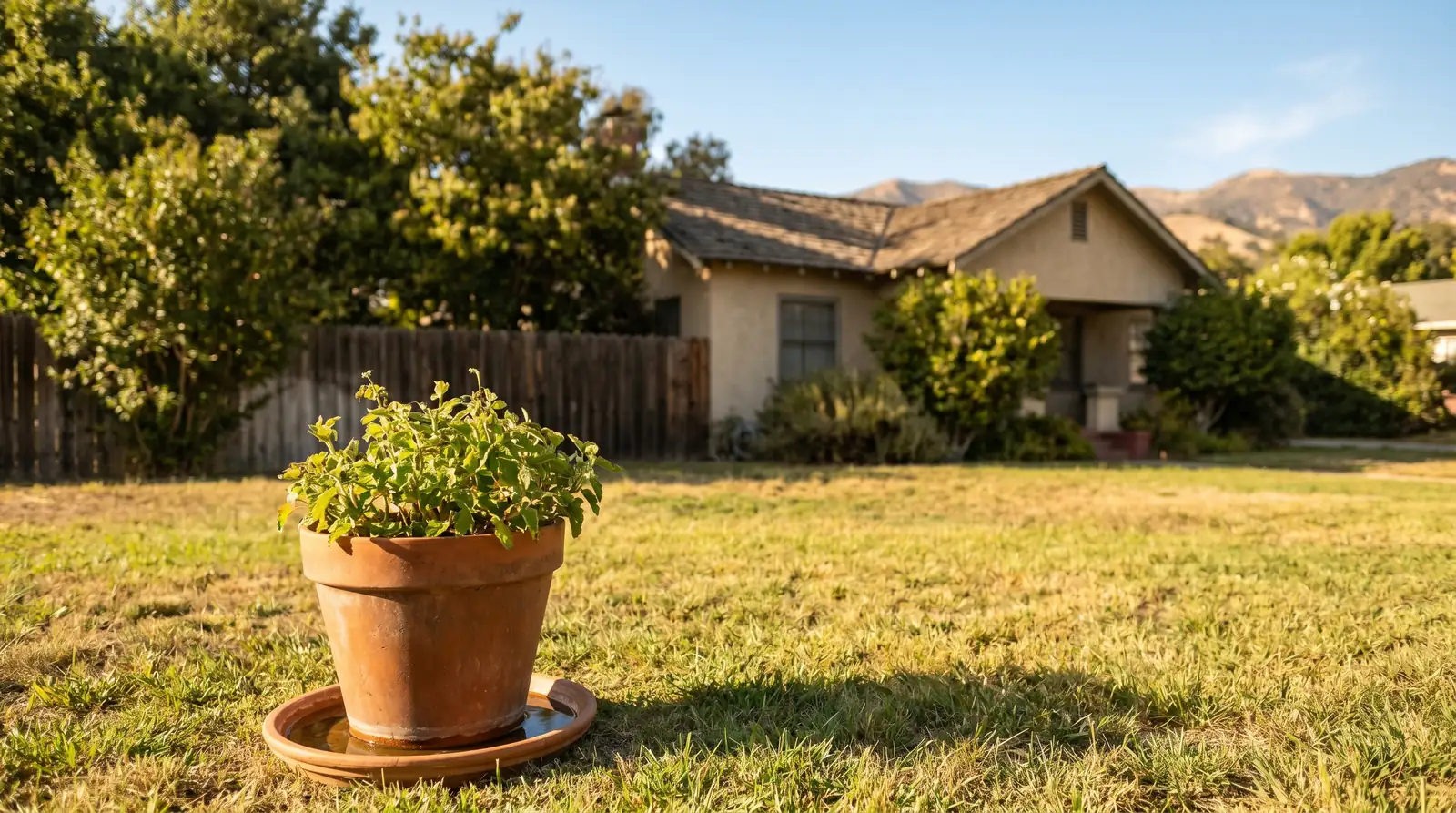
The invasive Aedes aegypti is a small, black-and-white, aggressive daytime biter that enters and stays inside homes and preferentially bites the lower legs and ankles — hence “ankle-biter.” It is a container breeder: any standing water in a tiny container such as a plant saucer, birdbath, pet dish or bottle cap can breed hundreds, and only about a teaspoon of water is needed for larvae to develop. It was first detected in California in 2013 in Madera and Clovis and has since established in Fresno County, with confirmed breeding documented in Firebaugh and Mendota. Aedes aegypti can transmit yellow fever, Zika, dengue and chikungunya, but those diseases have not been reported as locally transmitted in Fresno County — the established risk here is its bite and nuisance, not local outbreaks. For a full species breakdown, see our guide to the types of mosquitoes in California.
When West Nile virus risk peaks in the Central Valley
West Nile virus risk in the Central Valley peaks from roughly July through October, with human cases historically cresting in late August to early September. Research on California West Nile activity shows about 90% of West Nile-positive mosquito pools are collected during July–October, most of them in the first week of August, and the CDC similarly describes the U.S. mosquito-and-virus season as building in summer and continuing through fall. The Central Valley is one of California's historically highest-risk regions for the virus because its irrigated, flat landscape is ideal habitat for the Culex tarsalis vector. Most people who are infected never develop symptoms, but the risk is real enough that mid-to-late summer is exactly when bite avoidance and yard treatment matter most. For symptoms, who is at risk, and the local picture, read our deeper guide to West Nile virus in California.
Do mosquitoes go away in winter?
Mosquitoes do not fully disappear in a Fresno winter — activity drops sharply in the cold months, but it does not hit zero. Overwintering adult mosquitoes and dormant eggs persist through winter, and in a mild Central Valley winter the container-breeding Aedes “ankle-biter” can remain a near-year-round nuisance. That is why standing-water control is worth keeping up even in the off-season: any water that survives the cold is a head start for the next generation. So while you'll be bitten far less between November and March, the right mindset is “low season,” not “no season.”
When to start and stop treating your Fresno property
For Fresno-area homeowners, the practical window is to begin prevention and treatment in early spring, around April, and maintain it through fall, around October — the active season — with year-round attention to standing water.
Early spring (around April) — start before the peak. Walk your yard and eliminate standing water (plant saucers, clogged gutters, leaky irrigation, dog dishes, yard drains, tarps, buckets), then begin treatment while mosquito numbers are still low.
Summer (June–September) — stay consistent. This is peak activity and peak West Nile risk, so a recurring schedule beats one-time sprays; heat lets new generations replace knocked-down adults in about a week, so gaps in coverage show up fast.
Fall (through October) — don't quit early. Warm Valley evenings keep mosquitoes biting into October, and West Nile risk stays elevated through the fall, so finish the season before easing off.
Winter (November–March) — keep watching water. Activity is low, but clearing any standing water now denies the next season a foothold.
Because the season is long and the life cycle is fast here, a recurring program that combines source reduction with barrier treatment generally holds up better than a single seasonal spray. Total Pest Control Fresno builds mosquito plans around this exact April–October rhythm with a two-step method — a botanical EcoVenger ER-3 barrier treatment of the vegetation where adult mosquitoes rest, plus larval source reduction of the standing water that breeds them — rather than relying on passive In2Care stations. See how professional mosquito control works, or explore our mosquito control services to time your first treatment.
The public districts run all season too — but they don't treat your backyard
Fresno-area public mosquito districts work all season, but their job is area-wide surveillance and reactive control — not scheduled treatment of your backyard. The City of Fresno and surrounding communities are covered by tax-funded special districts such as the Fresno Mosquito and Vector Control District and the Consolidated Mosquito Abatement District (which covers Clovis, Selma and much of eastern Fresno County). Through the season these districts trap and monitor mosquitoes, treat public standing water, stock no-cost mosquitofish, respond to neglected-pool and service requests, and track West Nile virus. Their adult-mosquito spraying, however, is reactive — triggered by disease detection or unusually high mosquito numbers in an area — rather than a routine residential service. The scheduled, on-property treatment a homeowner needs across the April–October season is the part a private service fills; see our guide on the abatement district vs a private service.
Mosquito season FAQ
When does mosquito season start in California?
In California's Central Valley, mosquito season typically starts in mid-April as temperatures warm, and runs through October. There is no fixed start date — it shifts a few weeks each year with the weather, and warm springs can push activity earlier. April is the practical month to begin prevention and treatment, before populations build toward the summer peak.
When is mosquito season at its worst in Fresno?
Mosquito activity and disease risk peak in Fresno during the hot summer months, roughly June through September, with July often the most intense because heat lets the egg-to-adult life cycle finish in a week or less. West Nile virus risk specifically peaks from July through October, and human cases historically crest in late August to early September.
Why is mosquito season so long in the Central Valley?
The Central Valley has a long, intense mosquito season because of its flat topography, extensive agricultural irrigation and reliable summer heat. Standing water gives mosquitoes endless breeding sites, and the heat accelerates their life cycle so a full generation can complete in about a week, keeping overlapping generations active from spring into fall.
When does West Nile virus risk peak in California?
West Nile virus risk in the Central Valley peaks from roughly July through October. About 90% of West Nile-positive mosquito pools are collected during that window, most in early August, and human cases historically crest in late August to early September. The Central Valley is one of California's historically highest-risk regions for the virus.
Are there still mosquitoes in winter in Fresno?
Mosquito activity drops sharply in winter but does not stop entirely. Overwintering adults and dormant eggs persist through the cold months, and in a mild Central Valley winter the invasive Aedes aegypti ankle-biter can remain a near-year-round nuisance. Clearing standing water in winter helps prevent a strong start to the next season.
When should I start and stop treating my yard for mosquitoes?
For Fresno-area homeowners, the practical window is to begin prevention and treatment in early spring, around April, ahead of the peak, and maintain it through fall, around October — the active season — with year-round attention to standing water. Because the season is long and the life cycle is fast here, a recurring program tends to hold up better than a single seasonal spray.
What is the difference between the Culex and Aedes mosquitoes in Fresno?
Native Culex mosquitoes (Culex tarsalis and Culex pipiens) are the Valley's main West Nile virus carriers and are most active in the early morning and evening, though in the Central Valley some bite at night and some by day. The invasive Aedes aegypti ankle-biter is an aggressive daytime biter that targets the lower legs, enters homes, and breeds in tiny containers; it was first found in California in Madera and Clovis in 2013 and is now established in Fresno County.
Stay ahead of Fresno's long mosquito season
The most effective way to handle a season this long is to get ahead of it instead of chasing bites in July. Total Pest Control Fresno is a family-owned company serving Fresno, Clovis, Madera and Fresno County with recurring mosquito programs built around the Central Valley's April–October season — combining standing-water source reduction with barrier treatment of the places mosquitoes rest. Call (559) 472-8200 or explore our mosquito control services to plan your timing.